Work About Contact

01 / 03 · CDK Global

Customer Record Merge

Role Lead UX Designer
Company CDK Global
Timeline 6 months
UX Strategy Flows

Overview

Cleaning up the records that already exist.

Car dealerships accumulate duplicate customer records over time — the same person appearing two, three, or more times in the system under slightly different names, phone numbers, or email addresses. Each duplicate quietly degrades the value of the data around it: customer history becomes fragmented, lifetime value calculations go wrong, and communication with the customer turns inconsistent and confusing.

Customer Record Merge tackled the problem that already existed — not preventing new duplicates from being created, but giving dealership staff a reliable, non-destructive way to identify duplicate records and merge them into a single, clean source of truth. The challenge wasn't just building the merge tool. It was building one that users could actually trust.

Duplicate records. Real consequences.

Root cause

Customers exist as multiple records in the system — with no reliable way to bring them together.

Over time, the same customer gets entered more than once: a different spelling, a new phone number, a second visit years later. Without a way to merge these records, dealerships are left managing fragmented data with no clean path to resolution.

Effect 01

Fragmented customer history

A customer's full story — past purchases, service visits, interactions — is split across records. Staff working with any one of those records are missing part of the picture, making it harder to serve the customer well.

Effect 02

Inaccurate lifetime value

When a customer's transactions are spread across duplicate records, their true lifetime value can't be accurately calculated. Dealerships lose visibility into who their most valuable customers actually are.

Effect 03

Confused customer communication

Duplicate records mean duplicate outreach — the same customer receiving multiple versions of the same message, or conflicting information, depending on which record is being used. It erodes trust and looks unprofessional.

Learning from the people who live with this problem every day.

01
User interviews
I started by talking to the users with the highest usage rates — the people most regularly dealing with the pain of duplicate records.
  • Identified users with highest frequency of duplicate-related tasks
  • Interviewed them about specific difficulties combining records
  • Mapped the workarounds they had developed on their own
  • Surfaced the mental models they used to think about merging
02
Model & build
I worked closely with engineering to design a merge model that protected data — non-destructive by design, so no information would be permanently lost.
  • Collaborated with engineering on a non-destructive merge model
  • Ensured merged records retained full history from both sources
  • Designed a UI to represent the new model clearly to users
  • Rebuilt the UI from scratch when initial version missed the mark
03
Validate & test
I brought the redesigned flow back to users to confirm it matched how they actually thought about merging — not just how the system modeled it.
  • Validated the new flow with the same users from research
  • Confirmed alignment with user mental models
  • Tested for comprehension, trust, and confidence in the outcome

Going back to the drawing board.

Partway through the project, it became clear the initial UI wasn't working. The interface accurately represented the underlying merge model — but that wasn't enough. Users couldn't reconcile what they were seeing on screen with how they understood the merging process to work. The mental model gap was too wide to bridge with copy or onboarding.
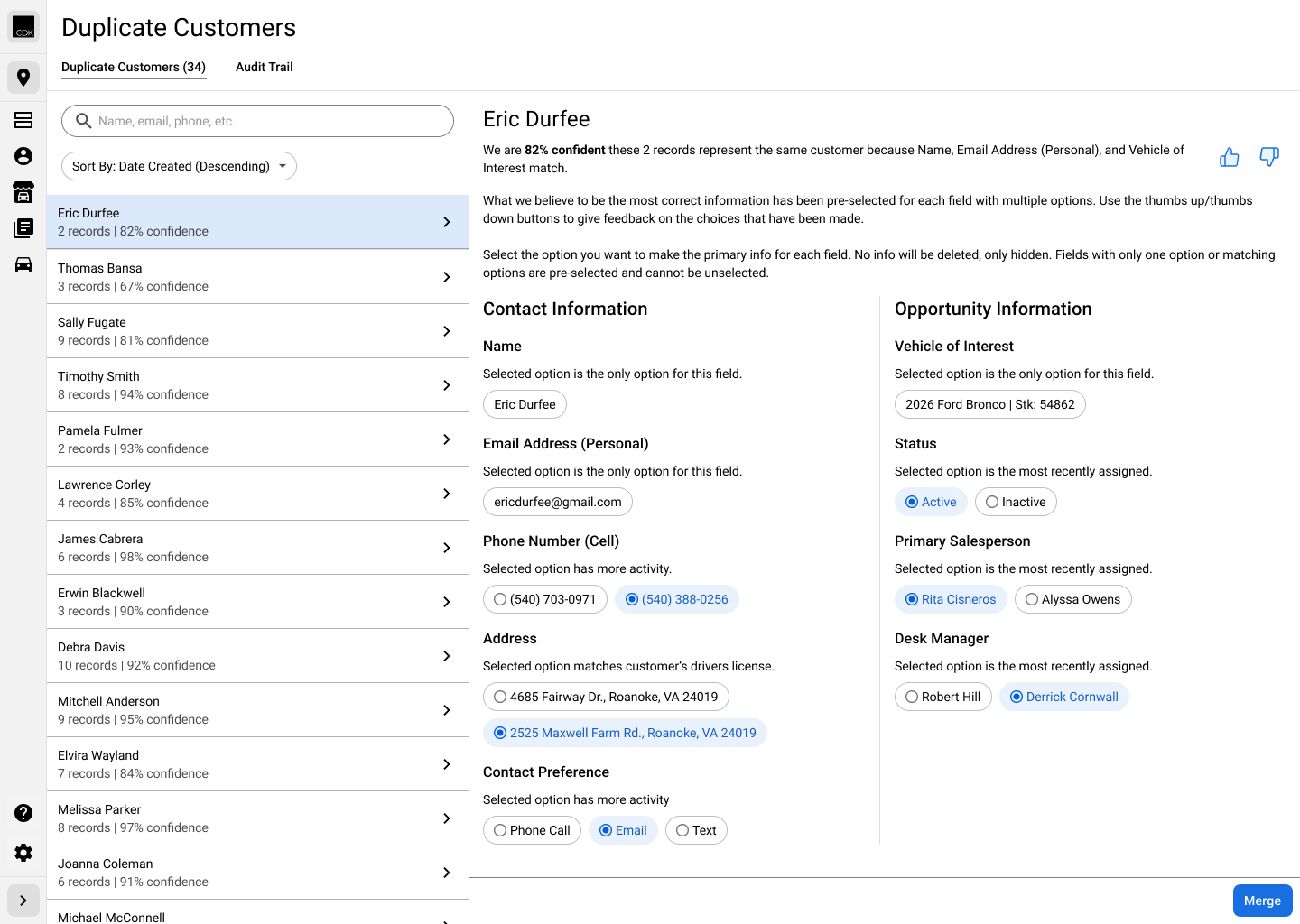
First draft duplicate customers dashboard

First version — Dashboard

Duplicate customers list with confidence scores and side-by-side merge panel

First version

Technically accurate. Conceptually broken.

The initial UI faithfully represented the new non-destructive merge model — but it was built around how the system worked, not how users thought about it. When tested, users struggled to understand what would happen to their data. Confidence was low. Trust was lower.

Scrapped

Rebuilt approach

Starting from the user's mental model.

Rather than adapting the existing UI, I went back to what research had revealed about how users thought about merging records — and rebuilt the interface around that understanding. The model didn't change; the way it was presented did. Users could now see exactly what would happen, and why.

Shipped

The insight

A UI that accurately represents the system model isn't enough if users can't map it to their own mental model. The cost of going back to the drawing board was real — but so was the cost of shipping something users couldn't trust.
Design work

From research to reality.

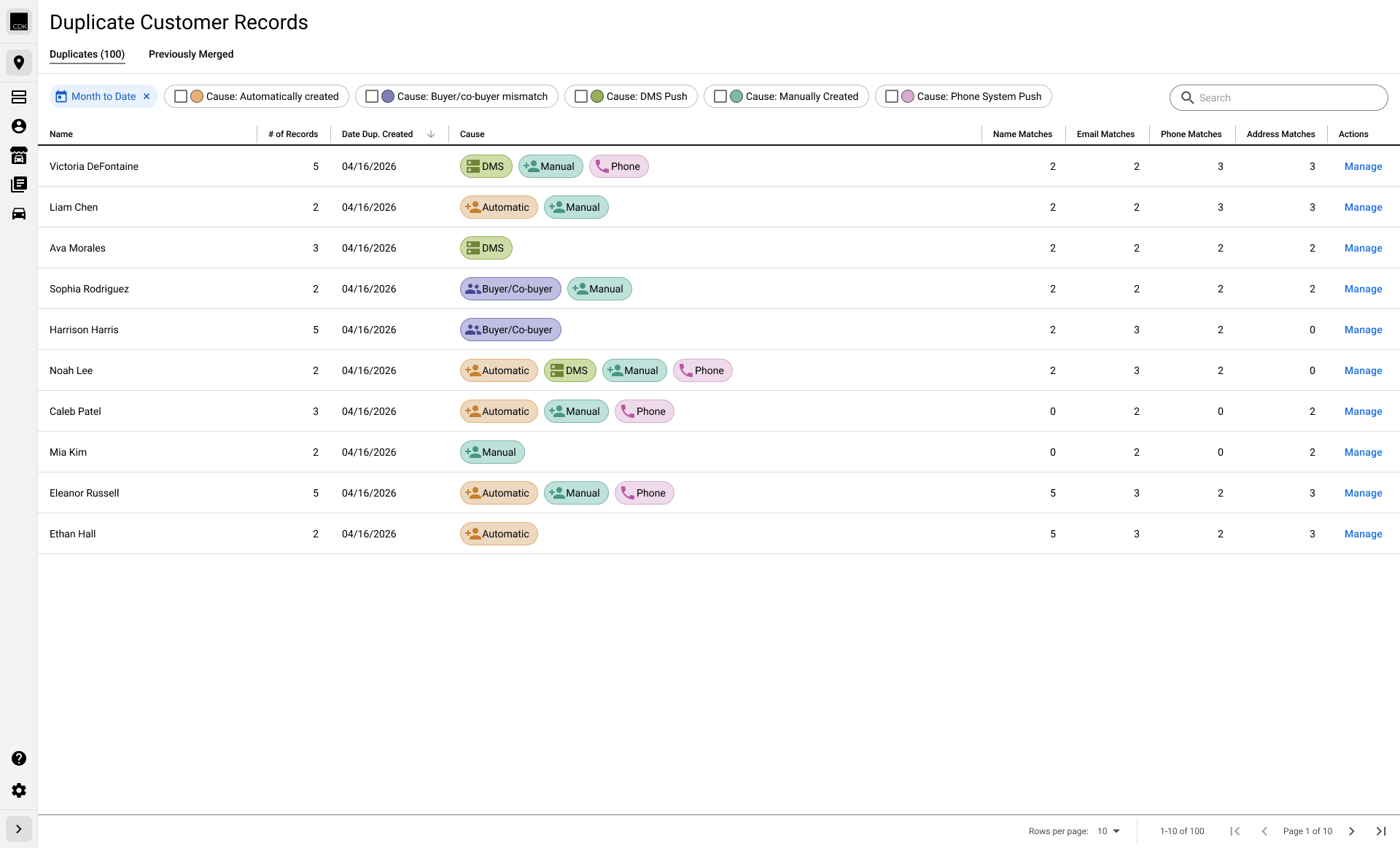
Duplicate Customer Records dashboard

Dashboard

Duplicate customer records — filterable queue with cause tags and match counts

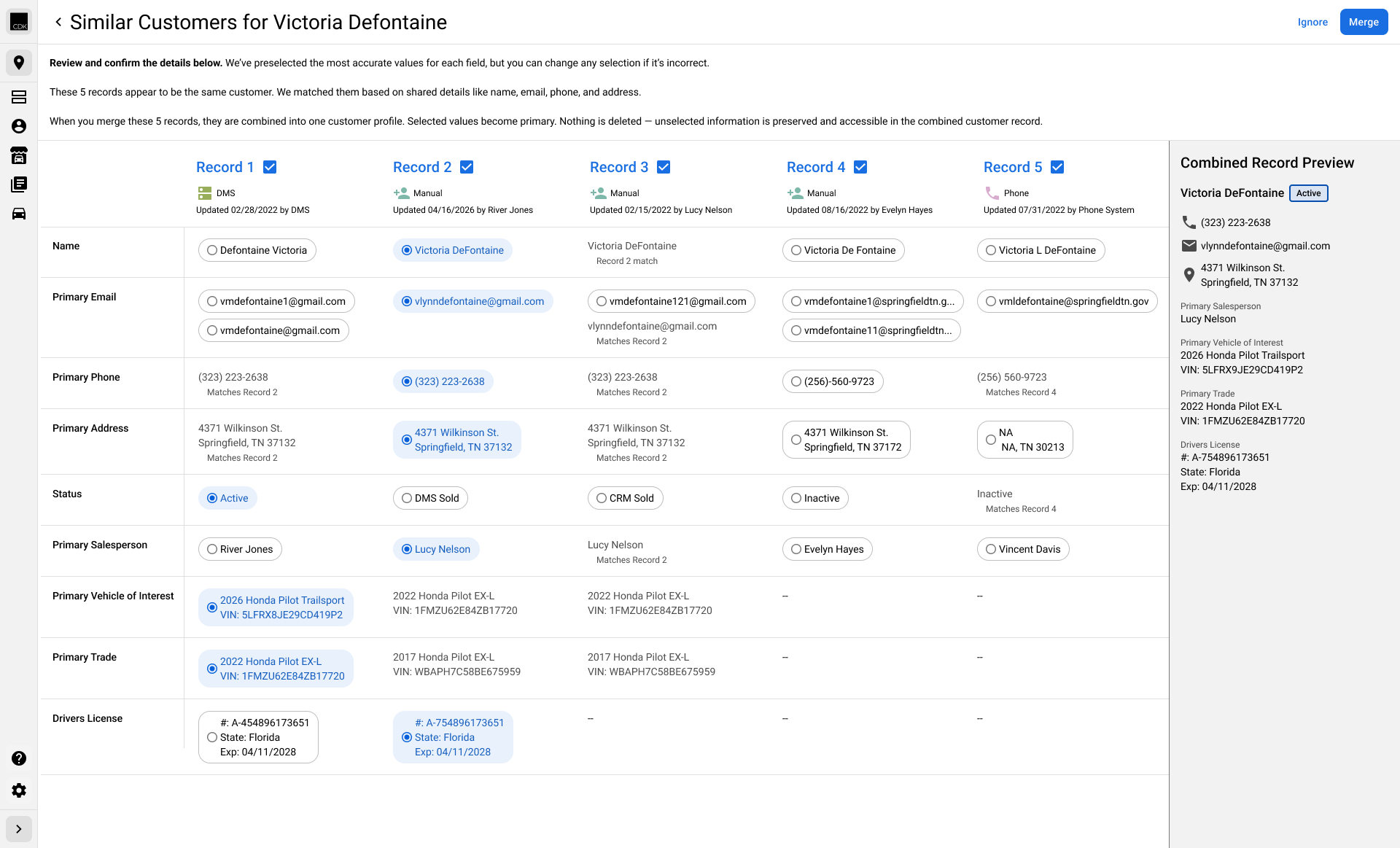
Similar customers merge screen for Victoria Defontaine

Merge screen

Field-by-field record comparison with pre-selected values and live combined record preview

Designed and ready. Deployment ahead.

Non-destructive merge model designed and built with engineering
Time spent managing duplicates — expected reduction post-deployment
Time available for higher-value tasks — the real goal behind this work

The redesigned merge flow — built around user mental models rather than the system's internal model — is complete. A non-destructive merge approach means no data is permanently lost when records are combined, giving dealership staff the confidence to actually use the tool rather than avoid it.

In progress

The project has not yet shipped. Once deployed, the expected outcome is a meaningful reduction in time spent manually managing duplicate records — freeing dealership staff to focus on higher-value, higher-impact work instead.

Next case study

BDC Pro

View case study